Blog
Amazon Future Engineer Scholarship
January 1, 2025Amazon Future Engineer students can boost their future for themselves and their community with the support of college funding, paid internships, and industry mentors. You can receive a scholarship of up to $40,000 (up to $10,000/year) towards an undergraduate degree in engineering or computer science and an offer to complete a summer internship at Amazon!
Deadline: January 9, 2025 at 3:00 pm Central Time
Visit the Amazon website to apply: https://www.amazonfutureengineer.com/scholarships
Eligibility Requirements
Live Más Scholarship
January 1, 2025Submission Deadline: January 8, 2025, 5:00 PM PST
See even more reasons to apply here!
ABOUT THE LIVE MÁS SCHOLARSHIP
No grades. No test scores. No essays.
The Live Más Scholarship is designed for students ages 16-26 who are pursuing higher education, preparing for the workforce, or using their passion to ignite change in their communities and beyond. All it takes is a two-minute video telling us what you’re passionate about and how you plan to make a difference.
This is your chance to be part of something bigger.
HOW WE SCORE YOUR APPLICATION
Your application will be evaluated based on four key criteria. Here’s how you can create a standout submission:
1. Passion
We want to know what drives you! Every passion has the potential to make a meaningful impact—whether it’s in food, dance, technology, art, or even supporting others. Show us:
- What inspires you and how you’re currently pursuing this passion.
- Why does this passion matter to you, and how does it drive you to make a difference?
Not sure what your passion is? No worries! Check out our tools and resources below to help you discover and cultivate it.
2. Impact
How are you turning your passion into action? We want to see how you’re making a difference in your community. This could be through:
- Volunteering at a local organization
- Inspiring friends and family
- Using media, art, or technology to drive change
- And more!
Show us your commitment to turning your goals into reality and the steps you’re taking to create a positive impact.
3. Storytelling
It’s not about fancy production—it’s about authenticity. We want to hear your story and what drives you. Share what makes you unique and passionate:
- Whether it’s a selfie video, a voiceover with images, or a simple recording, what matters is your story. Use free tools like Canva, TikTok, or Zoom to create a video that feels genuine to you.
Remember, your voice and story are what make you stand out. If you need help telling your story, we’ve got resources to guide you.
4. Educational Goals
Your education is part of your journey. Whether you’re pursuing a trade program, college, certificate, or degree, we want to hear how your educational plans align with your passion:
- How will your chosen education path help you pursue your passion and create a positive impact in your community, country, or even the world?
Where are our sons? Part I
January 1, 2025As a product of Chicago Public Schools and a first-generation college graduate, I have been researching and writing about Black male achievement since publishing my first book, “Don’t Quit—Inspirational Poetry” (1990). This led to me working with Black male students in the Los Angeles Unified Schools and Los Angeles Juvenile Court Schools in the areas of writing and public speaking. These experiences led to my engaging in independent research and publishing my first book specifically addressing issues of Black male achievement, “Empowering African-American Males to Succeed: A Ten Step Approach for Parents and Teachers” (1992). That book was followed by “Empowering African-American Males: A Guide to Increasing Black Male Achievement” (2005) and “Teaching, Parenting, and Mentoring Successful Black Males: A Quick Guide” (2007). Collectively, these books outlined research-based, research-responsive, and evidenced-based strategies supporting a systemic approach to increasing Black male achievement. So why are parents, teachers, mentors, coaches, administrators, and school superintendents still struggling with increasing Black male achievement? The simple answer is oftentimes the correct answer—they do not have the will.
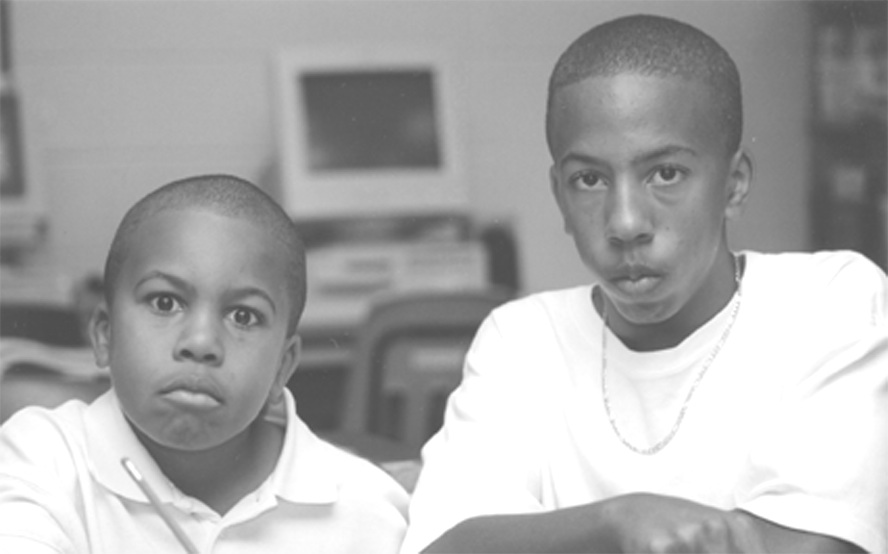
Not only in raising our two sons (pictured above) but also in providing college planning guidance for students, we have implemented successful strategies for increasing Black male achievement. For over 30 years, my wife and I have, through the countless hours of guidance provided to Black males through our first contracts with LAUSD in 1992 to our College Planning Program (which began in our church and expanded into our work in Florence School District 3 (SC), Guilford County Schools (NC), and Pinellas County Schools (FL)) my wife and I have continually honed and tuned the strategies presented in these respective books. We have many notable successes such as our younger son Jalani, a Gates Millennium Scholar; our older son Mychal-David, who received a BA in English from Amherst College; Sam Patterson, a Rhodes Scholar; Tar-U-Way Bright, an ELC Scholar; Julian Nelums, a Posse Scholar; Damian Lee, a Northeastern University Torch Scholar; Justin Cleckley, a Georgia Tech Gold Scholar; Justin Matthews, who received a BS in Physics from Dillard and a Master’s in Engineering from Georgia Tech; Chase Williamson, who is now attending Caltech; and many more. More broadly, however, over the past 30 years little has changed regarding Black male achievement.
Here’s Why
According to theU.S. Census Bureau, 50.8% of Black children are being raised in single-parent households. Of these, 46.3% are female-headed households. More Black children are being raised in single female-headed households than all other demographic groups combined. Consequently, single mothers raising Black boys need help; however, support from teachers, counselors, coaches, administrators, churches, community-based organizations, and mentoring programs is lacking. This reality should not be taken to imply that these respective groups of people do not want to be supportive, they simply are unwilling to do what is needed—at least as it pertains to increasing academic achievement. While every stakeholder in Black male success has an agenda, that agenda is rarely academic. Social workers want to keep Black boys in safe households; coaches want to keep Black boys on the team; fraternities and sororities want to make Black boys feel valued; the Boys & Girls Clubs want to keep Black boys off of the streets and out of the criminal justice system; school districts want to keep Black boys in school and decrease high school drop-out rates; churches want to teach the gospel and spread the good news; but none of these stakeholders has a mission to increase Black male achievement. Consequently, because this is not their focus, many, if not all, of these stakeholders are unwilling to do what is needed to increase Black male achievement.
 So What is Needed?
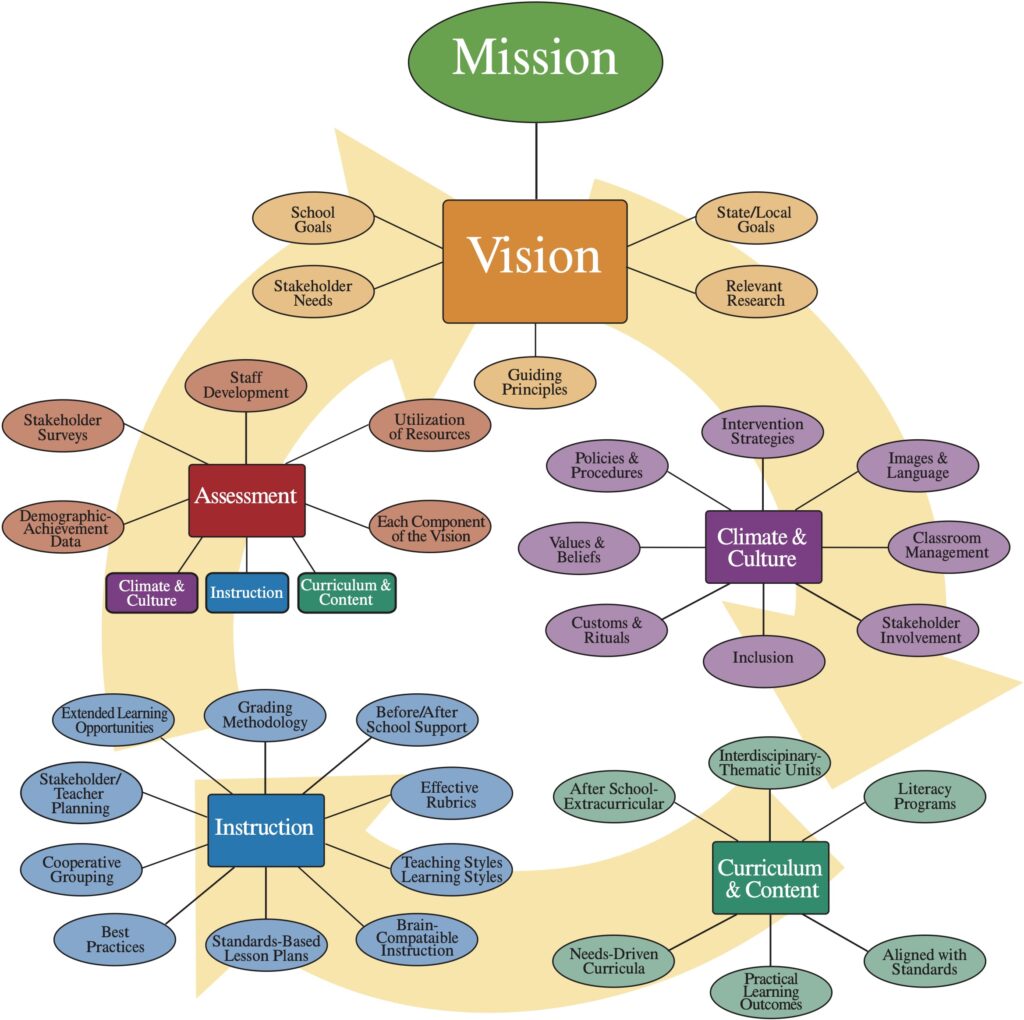
The illustration above reflects the comprehensive set of strategies required to achieve systemic and sustainable increases in Black male achievement (Empowering African-American Males, p. x). This is the process that we, as parents, followed to ensure our sons’ achievement, and that we have followed as college advisers to elevate Black males to achievement levels uncommon in their households, schools, school districts, and mentoring programs. These are proven strategies, but they require work and collaboration—work that few teachers, counselors, coaches, administrators, schools, school districts, mentoring programs, and churches are willing to commit to; and a level of collaboration with Black mothers that is almost exclusively social/emotional and rarely focused on student achievement.
Before disagreeing, consider the following questions for any parent, teacher, counselor, coach, mentor, church leader, or organization working with Black males:
- How many books and articles have you read about increasing Black male achievement?
- What is your “Mission” relative to increasing Black male achievement?
- What is your “Vision” of what Black male achievement looks and feels like?
- What is the “Climate and Culture” that you must develop to achieve your Mission and realize your Vision?
- What is the “Curriculum and Content” that you will rely on to achieve your Mission and realize your Vision?
- What is the “Method of Instruction” that you will use to achieve your Mission and realize your Vision?
- How will you “Assess” your success in achieving your Mission and realizing your Vision?
- How will you adjust your strategies based on your assessment?
This is hard work. Most parents, teachers, coaches, counselors, administrators, superintendents, clergy, mentors, and community-based leaders cannot agree on a shared mission and vision. Because of this, their strategies, no matter how well-intended, have and will continue to fail.
So Where are the Black Males?
Two of our school district partners, after experiencing the enormous success that we were having with their Black male population, decided that they could do it themselves and replicate our success. Their arrogance was astounding. They partnered with our foundation because of their history of failing to significantly increase Black male achievement. They witnessed our ability to achieve with a small budget what they were unable to do, despite spending millions of dollars annually. Then after a few years of observing our success, rather than increasing funding for our program, they canceled it in favor of pursuing replicating our program and results. Needless to say, despite spending a lot more money, both school districts have failed miserably in replicating our results. Why? Because there are no shortcuts.
One of our fraternity partners has learned that hosting monthly meetings without relying on a curriculum, planning the meetings, or following the process is easier, but will not result in significantly measurable increases in Black male achievement.
Even our church home, despite witnessing first-hand the 15-year success through our time as Education Ministry Leaders, was unable to continue the hard work that had resulted in nationally publicized success in increasing Black male achievement and expanding postsecondary access.
This is not to be taken as criticism of any people, organizations, or programs. I am simply pointing out that until people, organizations, and programs commit to the work—all of the work—Black males will continue to underperform academically.
Here is where we are today (12/31/24):
The National Assessment of Educational Progress is one of the many data sources providing insight into how dire the situation is.
2022 4th Grade Reading results for Black students:
- 56% below Basic
- 14% Proficient
- 3% Advanced
2022 8th Grade Reading results for Black students:
- 47% below Basic
- 14% Proficient
- 1% Advanced
2019 12th Grade Reading results for Black students:
- 50% below Basic
- 16% Proficient
- 1% Advanced
2022 4th Grade Math results for Black students:
- 45% below Basic
- 14% Proficient
- 1% Advanced
2022 8th Grade Math results for Black students:
- 62% below Basic
- 8% Proficient
- 1% Advanced
2019 12th Grade Math results for Black students:
- 66% below Basic
- 7% Proficient
- 0% Advanced
ACT 2024 National Profile Report
The underperformance of Black students on the national reading and math assessments should be a predictor, as they are, of Black college-bound student performance on the ACT.
Based on the 2024 ACT exam results, following are the percentages of Black students who met the college readiness benchmarks by subject area:
- 27% English
- 18% Reading
- 9% Science
- 8% Mathematics
- 5% All Four
As reflected in the story of Everybody, Somebody, Anybody and Nobody, where there was an important job to be done. Everybody was sure that Somebody would do it. Anybody could have done it, but Nobody did. Somebody got angry about it, because it was Everybody’s job. Everybody thought Anybody could do it, but Nobody realized that Everybody wouldn’t do it. It ended up that Everybody blamed Somebody when Nobody did what Anybody could have.
In the many years since I first published strategies for increasing Black male achievement, the story of Everybody, Somebody, Anybody, and Nobody is as relevant today as it was in 1992.
Spelman Check-in…
January 1, 2025 As indicated above, Joie is part of the 2024 ELC Scholars Cohort. Joie, a Georgia native and 2nd-year student in the Spelman College Honors College checked in to bring us up to date on the amazing experience she is having at Spelman College. Joie is part of a group of ladies who have been part of our program, and after weighing many college and scholarship options, chose to attend Spelman College. Joie is a CodeHouse Scholar and ELC Scholar pursuing a BS in Computer Science. Her journey epitomizes what we profile about HBCU opportunities in STEM in “HBCU STEM Pathways.”
Hey! I’m doing well. I love Spelman and being an honors student. This semester was my best and busiest yet. Here’s what I’ve been up to:
I traveled to DC for ELC’s Symposium. I had a wonderful time, learned a lot, and made meaningful connections. I also won an Apple Pencil for my attentiveness and dedication to note-taking during all sessions and a gift card for the best scholarship cohort (along with the other Ann Fudge Scholars). Then, in the same month I traveled to Pittsburgh for a Computer Science research conference at Carnegie Mellon University where I worked on a research project with a team and presented at the end of the conference (funded by Spelman’s CS Department). Shortly after I returned, I was notified that after applying and interviewing with multiple companies I received an offer to work at Meta in Menlo Park, California for a paid Software Engineering internship and I accepted that offer.
I also received a scholarship to attend the AfroTech Conference in Houston, Texas in November and the company, Rewriting the Code, that funded my trip asked me to do an Instagram Takeover on their company’s Instagram account. They said it was their best takeover yet!
I also recently received a $5,000 scholarship from the Computer Science Department at Spelman. I ended my semester with being asked by CodeHouse to speak to high school computer science students at Benjamin E. Mays High School along with 3 other CodeHouse scholars in my cohort. I did all of this while taking 19 credit hours, and ending the semester with all A’s so far (I am still waiting on one more final grade, praying that one will be an A as well.)
On January 6th, I will be headed to Google’s headquarters in Mountain View, California for the orientation of a selective and rigorous program called Google Tech Exchange where I will be taking classes from Google employees during the spring semester. I also have been taking dance classes here and there where my schedule permits. I am not taking as many credits this semester so, I am planning to sign up for classes at the Atlanta Ballet next semester so I can continue pursuing my passion.
Joie landed these many opportunities because she was been intentional in developing her pre-college plan and building her résumé throughout high school. Not only did those efforts pay off with being offered admission to the Spelman College Honors College, but contributed to here selection as a CodeHouse Scholar during the summer prior to entering Spelman.
Since enrolling at Spelman, Joie has continued to be intentional in building her résumé, which we assisted her in transferring into a CV format. She has been active in the honors program; a member of Girls Who Code; a member of Spelbots, a robotics club; joined the National Society of Black Engineers; joined the Pre-Alumnae Association; and volunteered throughout the Atlanta area including mentoring middle school and high school students.
Joie is one of the students profiled in HBCU Scholarships…and more*.
Jocelyne is Brown Bound…
January 1, 2025Brown Bound…
 Jocelyne, a senior in the IB Program at St. Petersburg High School (FL), attended our summer College Planning Boot Camp as a rising 6th grader. She went on to join our college planning cohort program as an 8th grader, served on our youth leadership board throughout high school, founded a College Cohort Club at her high school, contributed to both our “Who I Am” book series and the ACT Study Skills and Learning Strategies project. The many years of leadership and community service Jocelyne contributed to our foundation supported her application to Brown.
A Fortuitous Meeting
I met Jocelyne during the summer of 2019, when, as a rising 6th grader, she attended our 5-day College Planning Boot Camp through our partnership with Pinellas County Schools (FL). Intellectually curious, deeply pensive, and with an infectious laugh, she was destined to become a mainstay in our program. She attended our boot camp again as a rising 7th grader where she volunteered to serve as a discussion group leader. As an 8th grader, she formally joined our College Planning Cohort Program for high school students. As a 9th grader, she became a Co-President of our Youth Leadership Board. As a sophomore, she founded a College Cohort Club at her high school to assist expand the college knowledge of other first-generation students.
Jocelyne has become one of the most accomplished students in the history of our program. If not the most successful in processing and applying the information in every aspect of her approach to schooling. She embraced our 3 pillars of scholarship, leadership, and service in ways that have had an indelible and lasting impact on our foundation, in the lives of students at her school, in our national program, and in the lives of her family.
Plan Your Recommendation
As a middle school and first-generation student, Jocelyne was completely unaware of the potential impact a recommendation could have 7 years later during Brown’s review of her college application—but we did. During her 7-year middle through high school progression, Jocelyne followed our guidance and developed a long list of achievements in our program—all of which I was able to recount in the recommendation letter that I wrote to support her application to Brown.
Jocelyne wrote the bylaws and started the first chapter of our College Cohort Clubs at her St. Petersburg High School. Promoted the club via TikTok, resulting in over 50 students at each eat and learn lunchtime meeting. Her outreach efforts have resulted in amazing outcomes for many first generation students at her high school, one of whom was recently offered admission to Caltech. Jocelyne’s coaching guided her older sister as the first in their family to attend college into Johns Hopkins University.
Jocelyne has served as a literary and artistic contributor to our “Who I Am” series of books developed to provide guidance for students in grades 6 – 12 across such topics as personality types, multiple intelligences, temperament, mindset, grit, and learning styles. She has also served as a discussion group leader in our monthly virtual meetings of students from throughout the country and as an instructor for both middle school and high school students at our summer college planning and study skills boot camps. In all of these roles, Jocelyne has demonstrated patience, has prepared lesson plans, and has created surveys to assess her effectiveness in working with students. All of these actions have been done with a genuine desire to help others and to make a difference in their lives.
As a small CBO, our foundation is unable to devote significant time to training or monitoring our student volunteers. We seek students with whom we can share an idea and plant a seed. We then trust students to nurture the seed and achieve results using their own skills, creativity, and critical thinking. In Jocelyne’s situation, despite balancing our program with the academic demands of the IB Program at her high school, her incredible work ethic has consistently produced results, no matter what the task. She brought together 2 other first generation students from her community to create a podcast, “The Undebatable Relatables” (https://www.youtube.com/watch?v=JJei2XUTXEA) to provide college planning guidance; collaborated with students from Florida, Georgia, and South Carolina to create a Black History Month and Lunar New Year Tribute video (https://www.youtube.com/watch?v=pd4NPSmBjRI); and she led the collaborative effort to write the script and develop a promotional video for our foundation ((https://www.youtube.com/watch?v=LXWS9LMmTo8&t=4s).
Beyond these already significant accomplishments, Jocelyne led an ACT Study Skills and Learning Strategies project with the goal of assisting more first generation and under-resourced students with developing the skills to become better learners; expand their understanding of encoding, retention, and retrieval; and develop a working understanding of the forgetting curve—all focused on increasing academic performance in school and their performance on the ACT. When we presented this idea to Jocelyne, she took off to identify student contributors for each ACT subject area. She developed a collaboration with academically accomplished students in Florida, Georgia, and Iowa. Her leadership resulted in developing the foundation for the project and a 300-page working document that other students will continue to develop as she moves on in preparation for college. One of the contributors on the project is an alumna of our program who is a current PhD student in math who has agreed to continue collaborating with Jocelyne until the project is published.
I have treasured the 7 years that I have worked with Jocelyne and gotten to know her family. She comes from a loving and supportive household, through which she has been nurtured into an extraordinary young woman of impeccable character. While she is a passionate debater and full of ideas, she is respectful of both adults and peers; listens attentively; and articulates herself passionately. She is as aspirational in her personal goals as she is inspirational to peers. In so many ways I believe she will add value to your campus community, be an immediate contributor to campus-based organizations, and a joy to have in the classroom.
Lesson Learned…
The lesson to be learned from Jocelyne’s story is for every student to look beyond grades and test scores (although you must commit to pursuing academic excellence) towards committing yourself to an activity in which you can lead and serve in ways that make an impact on the lives of others. Then, as you apply to college or for scholarships, the faculty adviser, coach, supervisor, or organization can support your application through their first-hand testimonials of your impact on their club, team, workplace, or organization.
Taylar has great options…
January 1, 20252 Full Scholarships…

Taylar, a senior at Kennesaw Mountain High School (GA), joined our College Planning Cohort program as a rising 9th grader. She has already been offered two full scholarships: The Dovey Johnson Roundtree Class of 38 Presidential Scholarship to Spelman College, and the Board of Trustees Scholarship to Xavier University of Louisiana. She is waiting to hear from other schools, but her hard work has definitively resulted in a cost-free undergraduate degree as she prepares to apply to medical school.
While establishing herself as a top academic student, Taylar was selected as first chair of her middle school band. Upon entering high school, she committed to long hours of practice and began regularly watching YouTube videos of the greatest flautists’ performances and solos. She wanted not only to learn how to master her instrument but to infuse emotion into each melody. Every day she carved out time to practice to perfect her craft and, by the end of the first semester, she was selected as the first chair flute in the Concert Band. The next semester she moved up to the Symphonic Band, and as a sophomore, she joined the Wind Symphony. In her junior year, she was the flute section leader of the marching band and entered her final year of high school as the Woodwind Captain.
Taylar demonstrated deep and emphatic thinking in her response to Spelman College’s prompt, “The Spelman tagline is ‘A Choice to Change the World.’ If you could create meaningful change around one issue in your school, community, or globally, what would it be and how would you approach making this change?” Taylar provided a comprehensive response in which she identified underage substance abuse as a problem that plagues schools and communities, then she provided a set of strategies to address the problem.
Taylar is an example of a student who embraced our guidance of “be intentional in building your résumé.” Following this guidance resulted in significant and sustained involvement in such activities as:
- Founding LGND (Legend), a nonprofit focused on fundraising for underfunded school programs and creating volunteer opportunities for teens;
- Serving as a tutor for an annual SAT Boot Camp, requiring lesson plan development, facilitating sessions, and providing feedback to assist students in increasing their SAT performance; and
- Became the President of BOND (Black Organization Nurturing Diversity), where she organized Black History Month events, increased awareness of Black history, and scheduled guest speakers, including HBCU admissions advisers and social justice advocates.
Taylar’s leadership across these and other activities, as well as her engagement in meaningful community service, established her as a top candidate for the two highly competitive scholarships that she was offered. Her academic achievement demonstrated to her prospective colleges that she is academically capable; her leadership and service demonstrate that she will bring value to her college community.
Erin is in a quandary…
January 1, 2025Decisions…

Erin, a senior at the Kennesaw Mountain High School Academy of Mathematics, Science, and Technology (GA), joined our College Planning Cohort Program as a rising 9th grader. In addition to being offered admission to Rice University, she has been offered the Distinguished Presidential Scholarship to Tuskegee University. Erin is planning to attend medical school and finds herself in a quandary. Which school should she choose? What would you do?
Erin is not only smart, she is coachable. Throughout high school, she worked through our online curriculum, demonstrated genuine intellectual curiosity about the college planning strategies that we were proposing, and made a commitment to assuming leadership roles in our foundation as well as contributing many community service hours to supporting our efforts.
Erin was a contributor to our ACT Study Skills and Learning Strategies project and served as an intern researching HBCU early acceptance medical school pathways and dual degree programs. Erin wrote the student’s perspective forHBCU Healthcare Pathways.
Before researching graduate school and medical school pathways through HBCUs, I had little preexisting knowledge of such HBCU pathways, specifically into medical school. When Mr. Wynn asked me to research these pathways. I believed that even if these pathways existed, they would be out of reach for the majority of students and worse, scarce to find. Through my research, I have found myself to be wrong on both accounts. I was astonished to learn how successful HBCUs are in creating such pathways and how accessible they are to students who want to plan pathways into graduate school, medical school, dental school, optometry school, veterinary school, or nursing school. I am confident that such pathways also exist for law school, but that was outside of my research focus. The purpose of these pathways and partnerships is to rid students of socioeconomic barriers that prevent them from pursuing higher education and to provide assurance that if they commit themselves to doing the work to meet the admissions criteria for their desired program then they will be assured of the opportunity to fulfill their dreams.
HBCUs have partnerships with graduate schools within and outside of the United States. Several even have partnerships with Ivy League schools. These partnerships can come in the form of early assurance or dual degree programs. Early assurance for a pre-med student would mean that a student would get to apply to medical school early so that a medical school would be able to offer them an early decision and a guaranteed spot. For some programs, you can choose whether or not to take the MCAT. This is a great opportunity because applying to medical school is very expensive and filled with stress and uncertainty with such low medical school admissions rates. Applicants can spend thousands of dollars in transportation expenses traveling to medical schools for in-person interviews, MCAT study tools and preparation fees, exam fees, and so much more without any guarantee of being accepted into medical school. I learned that many early assurance programs invite students to all-expenses-paid summer programs where they can receive a stipend, attend MCAT preparation classes, and gain research experience.
Dual degree programs allow students a guaranteed pathway to receiving an undergraduate and graduate, or undergraduate and medical degree. Many such programs are not only guaranteed but take less time and cost less money than would otherwise be required. For me personally, being assured of the institution where I will earn my undergraduate degree and the institution where I will earn my graduate degree or attend medical school prior to graduating from high school allows me to plan both my long-term career goals and short-term academic, leadership, and community service goals.
Many HBCUs are amazing in the sheer number of partnerships they have developed but the reverence with which they are referred to is nonpareil and are frequently featured on the websites of their partner institutions. Take, for instance, Jumoke Dumont’s article “50 Years of Medicine: The Brown-Tougaloo Partnership,” which describes the Brown University-Tougaloo College partnership:
“For 154 years, Tougaloo College, a historically black college (HBC) in Jackson, Mississippi, has played a leading role in the education of Black scientists and health professionals in the South and beyond.
The private liberal arts college is among the top US schools for the number of graduates with doctoral degrees in STEM fields, and its alums form 40 percent of Mississippi’s African American physicians and dentists.
Brown became an active partner in this tradition in 1976 when it established the Early Identification Program in Medicine for Tougaloo (EIP). An expansion of the historic Brown University-Tougaloo Partnership (BTP), the EIP identifies Tougaloo undergrads for early acceptance to Brown’s MD program.
The EIP in Medicine for Tougaloo is one of the BTP’s longest-standing active programs. It has produced two generations of physicians — MDs who are leaders in their fields and the communities they serve.”
During my research, I discovered that one HBCU had partnerships with 16 graduate schools (Xavier University of Louisiana). That means there were 16 different pathways available to students for early assurance and dual degree programs. Through my research for this project, I dispelled any preexisting notions about the quality of education or scope of opportunities offered at HBCUs and learned how committed HBCUs are to not only the success of their students, but in creating leaders like Vice President, and presidential candidate Kamala Harris, who has already had a global impact. These schools work hard to ensure that after their students receive their undergraduate degree, they have the best opportunities for continuing their education into graduate school, medical school, law school, or beyond.
As a result of my research, I now understand how and why HBCUs have such a rich and long history of producing Black professionals in virtually every career field from education to medicine and from the arts to STEM. The amount of support and tools HBCUs provide to help students pursue their educational and career aspirations is such an important feature of HBCUs. Based on indisputable outcome data, their strategies are arguably more effective for African American success than those of other highly selective schools.
Erin N.
Kennesaw Mountain High School Class of 2025
Academy of Mathematics, Science, and Technology
Newsletter: December 1, 2024
December 2, 2024


HBCU Healthcare Pathways
November 12, 2024Erin, an academically accomplished high school senior (GPA 4.5; ACT 33) attending the Kennesaw Mountain High School Academy of Mathematics, Science, and Technology Magnet Program has earned leadership and community service hours as a high school intern with our foundation. Erin’s most recent responsibility was serving as a researcher on this project. Erin, who has aspirations of attending medical school, shares her perspective regarding what she learned through her research.
 Prior to researching graduate school and medical school pathways through HBCUs, I had little preexisting knowledge of such HBCU pathways, specifically into medical school. When Mr. Wynn asked me to research these pathways. I believed that even if such pathways existed, they would be either out of reach for the majority of students, or scarce to find. Through my research, I have found myself to be wrong on both accounts. I was astonished to learn how successful HBCUs are in creating such pathways and how accessible they are to students who want to plan pathways into graduate school, medical school, dental school, optometry school, veterinary school, or nursing school. I am confident that such pathways also exist for law school, but that was outside of my research focus. The purpose of these pathways and partnerships is to rid students of socioeconomic barriers that prevent them from pursuing higher education and to provide assurance that if they commit themselves to doing the work to meet the admissions criteria for their desired program that they will be assured of the opportunity to fulfill their dreams.
HBCUs have partnerships with graduate schools within and outside of the United States. Several even have partnerships with Ivy League schools. These partnerships can come in the form of early assurance or dual degree programs. Early assurance for a premed student would mean that a student would get to apply to medical school early so that a medical school would be able to offer them an early decision and a guaranteed spot. For some programs, you can choose whether or not to take the MCAT. This is a great opportunity because applying to medical school is very expensive and filled with stress and uncertainty with such low medical school admissions rates. Applicants can spend thousands of dollars in transportation expenses traveling to medical schools for in-person interviews, MCAT study tools and preparation fees, exam fees, and so much more without any guarantee of being accepted into medical school. I learned that many early assurance programs invite students to all-expenses paid summer programs where they can receive a stipend, attend MCAT preparation classes, and gain research experience.
Dual degree programs allow students a guaranteed pathway to receiving an undergraduate and graduate degree, or undergraduate and medical degree. Many such programs are not only guaranteed, but take less time and cost less money than would otherwise be required. For me personally, being assured of the institution where I will earn my undergraduate degree and the institution where I will earn my graduate degree or attend medical school prior to graduating from high school allows me to plan both my long term career goals and short term academic, leadership, and community service goals.
Many HBCUs are not only amazing in the sheer number of partnerships they have developed, but the reverence with which they are referred to is nonpareil and featured on the websites of their partner institutions. Take for instance, Jumoke Dumont’s article, “50 Years of Medicine: The Brown-Tougaloo Partnership,” which describes the Brown University-Tougaloo College partnership.
“For 154 years, Tougaloo College, a historically black college (HBC) in Jackson, Mississippi, has played a leading role in the education of Black scientists and health professionals in the South and beyond.
The private liberal arts college is among the top US schools for the number of graduates with doctoral degrees in STEM fields, and its alums form 40 percent of Mississippi’s African American physicians and dentists.
Brown became an active partner in this tradition in 1976 when it established the Early Identification Program in Medicine for Tougaloo (EIP). An expansion of the historic Brown University-Tougaloo Partnership (BTP), the EIP identifies Tougaloo undergrads for early acceptance to Brown’s MD program.
The EIP in Medicine for Tougaloo is one of the BTP’s longest-standing active programs. It has produced two generations of physicians — MDs who are leaders in their fields and the communities they serve.”
During my research, I discovered that one HBCU had partnerships with 16 graduate schools (Xavier University of Louisiana), thereby providing 16 different pathways to early assurance and dual degree programs. My research for this project dispelled any preexisting notions I previously held regarding the quality of education or scope of opportunities offered at HBCUs. I left the project with a much deeper understanding of how committed HBCUs are to not only the success of their students, but in creating leaders like Vice President, and presidential candidate Kamala Harris, who has already had a global impact. These schools work hard to ensure that after their students receive their undergraduate degree, they have the best opportunities for continuing their education into graduate school, medical school, law school, or beyond.
I hope that you will learn from reading this book, what I have learned— why HBCUs have such a rich and long history of producing Black professionals in virtually every career field from education to medicine and from the arts to STEM. The amount of support and tools HBCUs provide to help students pursue their educational and career aspirations is such an important feature of HBCUs. Based on indisputable outcome data, their strategies are arguably more effective for African American success than those of other highly selective schools.
Erin N.
Kennesaw Mountain High School Class of 2025
Academy of Mathematics, Science, and Technology
How to Plan Your Career or College Pathway
November 12, 2024 Planning a career or college pathway is not easy. While this book is only 128 pages, many teachers and counselors have concerns that there is too much reading and the concepts are too difficult for middle school and high school students to grasp. While I understand such concerns, my experience is that students are not only capable, but are receptive to the guidance being provided in this book. I recently spoke to classes of 9th grade students at a high school in Columbia, South Carolina where I asked students in each class to write a narrative response to the question, “What are your dreams and aspirations after high school?”
While there were many students who failed to write anything, and other students who only wrote one or two sentences about becoming rich or becoming a professional basketball or football player, there were a good number of students in each class who wrote introspective and self-reflective narratives.
“My dream is to become a choreographer at my own dance studio. It has been a dream that I have had since I was young. I am willing to put in whatever it takes to achieve my dream, no matter what. I love dancing, which has been my passion since I took my first steps.”
“My dream is to become a veterinarian and to own my own veterinarian clinic. I recognize that I have to overcome obstacles that I have in math and science. Today, after writing about my dreams and considering the obstacles, I now know the importance of working more closely with my math and science teachers who can help better prepare me for college.”
“My dream is to enlist in the Navy and pursue the Nursing Corps option. However, prior to today, I hadn’t thought about how I would actually achieve my dream. Now I know that to pursue the Navy Nursing Option, I will need to research each of the colleges that offer the NROTC Scholarship, and that have nursing programs. I will also need to know the type of academic performance I will need throughout high school to qualify for the scholarship. All in all, I now know that having a dream requires a lot more than just talking about your dreams!”
“My dream is to become a legendary comic book creator, artist, author, director, and horror film creator. My inspiration is Stephen King and Eiichiro Oda. My favorite kind of horror is Analog Horror, which depicts themes of VHS tapes and old school cartoons/movies.”
At the end of each class, students remained behind asking questions about what they could do to pursue their dreams. We talked about the available career pathways at their school, the type of classes they should take, and how to build their résumés to make themselves competitive job, college, or scholarship applicants. During the discussion about grades, every student acknowledged that they were not earning the grades of which they were capable. They were not engaging in their classes as well as they could. They were not studying at home or preparing for tests as well as they could. These students were repeatedly, and consistently, acknowledging that their work ethic was not aligned with their career aspirations.
I raised another question, “Why aren’t you doing the things that are consistent with [following] your dreams?” The common response was that they had not made a connection between what they were doing in school today and the future they dreamed of having for themselves.
My final question prior to the students leaving was, “If I wrote a book providing step-by-step guidance as to how to maximize the available choices in your school or school district to follow your dreams, would you read it?” Not only did every student respond, “Yes!” It was the look in their eyes that they wanted someone to help them to plan their way toward their dreams.
The students who will benefit most from this book are students who either have aspirations for the future, or want to identify the type of career pathways in which they can earn a living and enjoy the work. If you are such a student, but find the reading difficult, then read a few pages at a time and begin with the chapters that reflect your aspirations the most. If your career pathway is not covered in the book, then focus on the basic information about how to choose your middle school and high school classes and how to take maximum advantage of the CTE/CTAE or college prep classes available in your school or school district.
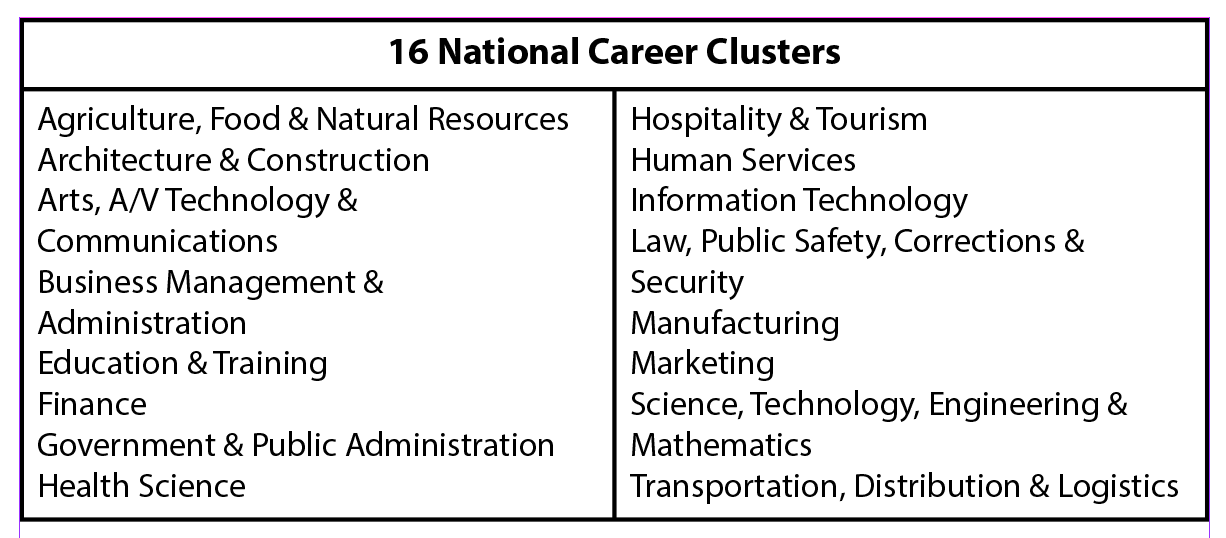
The table above lists the 16 career clusters reflected in The National Career Clusters Framework, which serves as an organizing tool for CTE programs. The clusters represent 79 different career pathways. If you are entering, or have already entered high school through one of these career clusters, then focus your efforts on taking the Interest Profiler presented in the chapter, “What Are Your Interests?” to confirm that your chosen pathway is aligned with your interests.
Maximizing the opportunities during middle school and high school to explore career clusters or CTE/CTAE classes, especially those reflective of your gifts, talents, and interests can provide important considerations for the career or educational pathway you choose to pursue after high school, which should help determine the classes that you take during high school.
The important consideration is that any of these career clusters can lead to pathways into the workforce, military, or college. Regardless of the career cluster you choose, you will have options of multiple career and occupational opportunities within a career cluster, such as technician, teacher, scientist, or veterinarian, as well as pursuing a workplace certification, associate’s degree, bachelor’s degree, master’s degree, or MD/PhD. Your choice provides your context for learning.
For every student who has dreams and aspirations for the future, even if you do not know what that future looks like, I have written this book with you in mind. I have also written, “Career or College Pathway: Individual Graduation Plan,” providing further guidance in planning and tracking a pathway toward your dreams for your future.